

Optimize Data Center Cooling in Four Steps
Balancing cost effectiveness with environmental responsibility can often pose challenges. However, data centers are a realm where these objectives can align seamlessly.
With rising energy costs and increasing data center demands, the importance of efficient cooling continues to grow. By adopting best practices, you can significantly boost your data center’s cooling efficiency and prepare for future needs.
Effective Sealing for Data Centers
A robust sealing strategy forms the bedrock of an efficient cooling plan. Poor sealing can lead to cooling losses and increased humidity, undermining cooling efficiency. Implement these measures to improve sealing:
- Ensure doors remain closed whenever possible.
- Create an effective vapor seal using plastic films, vapor-retardant paints, and vinyl coverings for walls and floors, providing a cost-effective environmental control.
- Seal gaps around cables and pipes penetrating walls and raised floors.
- Conduct a thorough assessment to detect and resolve sealing inefficiencies.
Arranging a Hot-Aisle/Cold-Aisle System
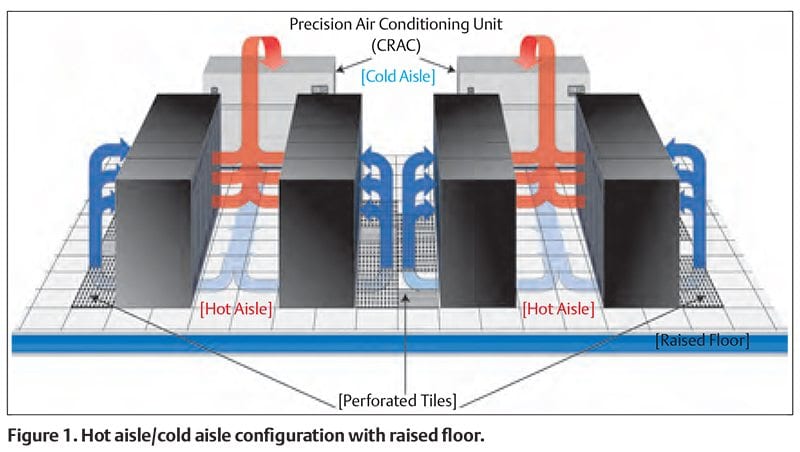 The hot-aisle/cold-aisle configuration focuses on minimizing the energy needed to dissipate heat from equipment. It enhances airflow, boosts CRAC unit capacity, and reduces energy requirements.
This system arranges racks face-to-face, drawing cool air from the cold aisle while expelling hot air through the rear, creating a distinct hot aisle. CRAC units placed perpendicular to these hot aisles benefit from increased return air temperatures, thereby improving efficiency.
Implementing Aisle Containment
After establishing a hot-aisle/cold-aisle setup, the next step is to incorporate aisle containment. This technique prevents the intermingling of hot and cold air by sealing the aisle with overhead panels and doors at either end. Aisle containment is cost-effective and easy to install, even with raised flooring.
This method not only heightens cooling capacity but also enhances CRAC unit efficiency by elevating return air temperatures, allowing for higher heat load management per rack. For further insights, refer to our white paper on Cold Aisle Containment.
Advanced Control Systems
Modern intelligent control systems like the Liebert DSE optimize cooling components, curtailing energy use and integrating well with data center management systems. Boasting up to 70% greater efficiency than other systems, the Liebert DSE employs dynamic fan control, compressor modulation, and remote sensors to precisely direct cooling where necessary.
The Liebert iCOM system further refines this by allowing independent operation of compressors and fans, matching room requirements and significantly reducing energy wastage.
Partner with Us for a Greener Future
As data center managers tackle heightened energy demands, efficient cooling strategies become paramount. Implementing these straightforward practices can help reduce energy expenditure, aiding your company in reaching its sustainability objectives.
At Computer Conditioning Corporation, we collaborate closely with you to devise practical energy-saving plans tailored to your needs. Most organizations can realize energy reductions with minimal modifications. Get in touch with your local Liebert partner today and embark on a greener journey!
FAQ: Data Center Cooling
Why is sealing important for data centers?
Proper sealing prevents cooling losses and humidity introduction, which are crucial for maintaining efficient data center cooling.
How does a hot-aisle/cold-aisle system improve efficiency?
By optimizing airflow and positioning CRAC units to benefit from higher return air temperatures, this approach reduces energy consumption and boosts cooling capacity.
What are the benefits of aisle containment?
Aisle containment prevents the mixing of hot and cold air, increases cooling capacity, and enhances CRAC efficiency by raising return air temperatures.